


By John Fitzgerald

(Part two)
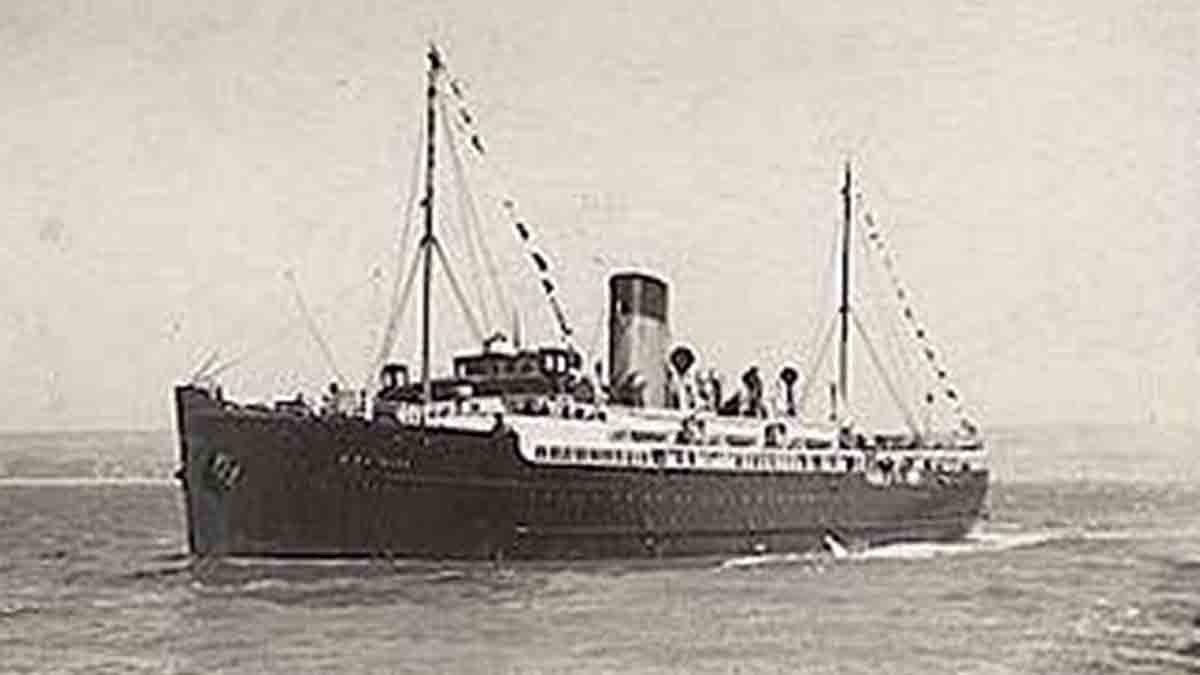
Kathleen Aylward (nee Murphy) of Mullinavat (and later Kilmacow) had what she believed was a miraculous escape in 1941 when the German airforce bombed the mailboat she was travelling on, the SS St Patrick. She was thrown overboard after the explosions, but was saved from drowning as a result of “divine intervention.” You can read part one of this story on the Observer website.
Kathleen had a vivid recollection of what happened next: “I was frozen and suffering from shock, and one of the men put his coat around me. I turned to thank him and discovered it was Willie McLoughlin. He had survived too! He had been worried about me and didn’t recognise me at first because I was covered in oil. Would you believe, Willie had been blown straight off the ship into the lifeboat. He wasn’t even wet!”
Kathleen was the only woman aboard the lifeboat, along with 35 men. They drifted for about three hours under a clear blue sky. The sun was shining, and all was peaceful, but they could see no sign of any other lifeboats or survivors. Then they heaved a collective sigh of relief: Three warships appeared on the horizon. One of these, the H.M.S. Indian Star, broke away from the convoy and approached the lifeboat.
The ship’s crew lifted the survivors safely aboard and provided them with food and fresh clothing. Eight hours later, the Captain informed them that the ship was nearing Milford Haven in Wales. At the port, members of the Salvation Army turned out to meet them and offer help.
“I was in a sad state”. Kathleen recalled, “Despite my best efforts, the oil was still in my hair and, what’s worse, floating in my eyes. I sought immediate medical treatment. Then my thoughts turned to the family back in Mullinavat. I knew they’d be worried sick. Willie had some loose change in his pocket so he sent a telegram to let our families know we’d both been rescued. I learned afterwards that we’d been given up in Mullinavat as lost, so the news came as a Godsend to the folks back home.”
A kindly shop owner in Fishguard, upon hearing that there was a girl among the survivors, sent a selection of clothing to Kathleen: “The war brought out the best in a lot of people!” she reminded me.
British Rail officials arranged for Kathleen and the others to be transported to their respective destinations. She was among those put on a train for London, and found herself in a carriage enveloped in total darkness. This was to comply with blackout regulations.
After a succession of delays caused by German bombing, the train reached Paddington Station in London at 6 am. Kathleen and Willie said goodbye to their fellow survivors and went to the house of Willie’s sister, Margaret, at Princess Street, Kilburn.
Willie gave Kathleen, who had no money, the underground fare to Liverpool Street where she caught a train to Colchester. She then walked the two miles to the home of her friends, John and Biddy Murphy, on Rawston Road.
Even after all the time that had passed, Kathleen appeared visibly moved when she described what happened next: “Biddy answered the door, and what a shock she got when she saw the state I was in. I couldn’t speak at first. I went in with Biddy and just cried and cried. The ordeal I had been through began to sink in.
“John and Biddy looked after me. I don’t know what I would have done without them. Biddy called to the hospital where I worked, explained what had happened, and I got three weeks leave of absence. Two other friends, Doris and Catherine came to visit me often and gave me gifts of money and clothing, as I’d lost everything I owned. After the three weeks rest, I was back nursing at the hospital.”
Kathleen never forgot the goodwill shown by her friends in that time of need. She treasured her memories of them: Willie McLoughlin was brother of Thomas McLoughlin of O’Connell Street, Waterford and John Mcloughlin, Mullinavat. Willie died on March 8th, 1971.
John and Biddy Murphy remained close friends of Kathleen’s until their deaths. John was a building contractor who hailed originally from Ballybrahee, Glenmore. He had a brother, Luke, of Ballybrahee and a sister, Stastia Furlong, of Glenmore.
Kathleen kept in contact with Doris and Catherine over the years. Doris became Mrs. Doris Diamante after moving to New York. She and her family visited Kathleen on several occasions, and Kathleen stayed in contact with them in the Big Apple. Catherine became Mrs. Catherine Flood of Adelaide, South Australia. She too remained a lifelong friend of Kathleen’s.
The memory of that strange and terrible sea voyage in 1941 was as vivid for Kathleen in 2002 when I visited her “as if it happened last week”, she assured me.
Though a frightening experience, she found in it evidence of a “Higher Power”.
“Those two amazing things stick out in my mind: Firstly, there was that switching from 1st class to 3rd class passage on the ship. The explosion would have killed me outright if Willie hadn’t suggested a change of booking.
“And then, when I was drowning, there was the voice that saved my life. I am one hundred percent certain that it couldn’t have emanated from a human source. There was no one near me, and under water I couldn’t have heard them anyway. I believe it was the voice of the one who watches over all of us”.
Mrs. Aylward was formerly Kathleen Murphy of Clonassey, Mullinavat. Her husband, James Aylward, died in 1972. She had five children: David, Marie, and Claire Aylward, Ballydaw, Shay Aylward, Newport, Co. Tipperary, and Bernard, London.
In her later years, Kathleen was a familiar face at the Young at Heart Club meetings and social gatherings in Mullinavat and Kilmacow. She was among the more active members of the group, which she had co-founded. The club brightened up the lives of countless people in South Kilkenny.
Kathleen said goodbye to the world in July 2009, but her memory lives on, including the story of that fateful day in 1941.