


BY JOHN FITZGERALD

(Part one)
As if rationing and belt-tightening weren’t challenging enough, another headache lay in store for neutral Ireland…twenty- seven months into the war. In the winter of 1941, as the German Army shivered and froze in the snowy wastes of Russia, an outbreak of foot and mouth disease ravaged Irish agriculture.
Meat exports were halted. Farmers panicked and farms were forced to close down. The entire economy seemed threatened. The government called for calm. And both the LDF and LSF were ordered to assist in an all-out national effort to beat the bug.
This emergency within an emergency caused more worry to farmers than even the threat of invasion. Callan was hit by the deadly affliction, the first traces of it in the district having been discovered in Killaloe.
The district figured prominently in the national scare. Catherine Morris was distraught and inconsolable when the Department of Agriculture confirmed the presence of the deadly disease was confirmed on her farm at Kylenaskeogh. Her livestock would have to be slaughtered and that not a single cloven-footed animal could remain alive on her farm.
The disease spread rapidly through the Callan district and threatened the Modeshill area in neighbouring County Tipperary. The Bovine Angel of Death also visited farmer James Ryan of Hugginstown, and Patrick Hoyne of Rathmoyle, Tullaroan after FMD seeped into their herds: The livestock they had worked so hard to rear for slaughter in the factories were instead condemned to an earlier demise in the open countryside.
As part of a major countrywide clampdown on cattle movements to contain the menace, the LDF was drafted in to man around-the clock observation posts at cross roads and other crucial locations. Department of Agriculture personnel tested herds and when any cow or bullock or other farm animal tested positive, they’d exterminate the entire herd.
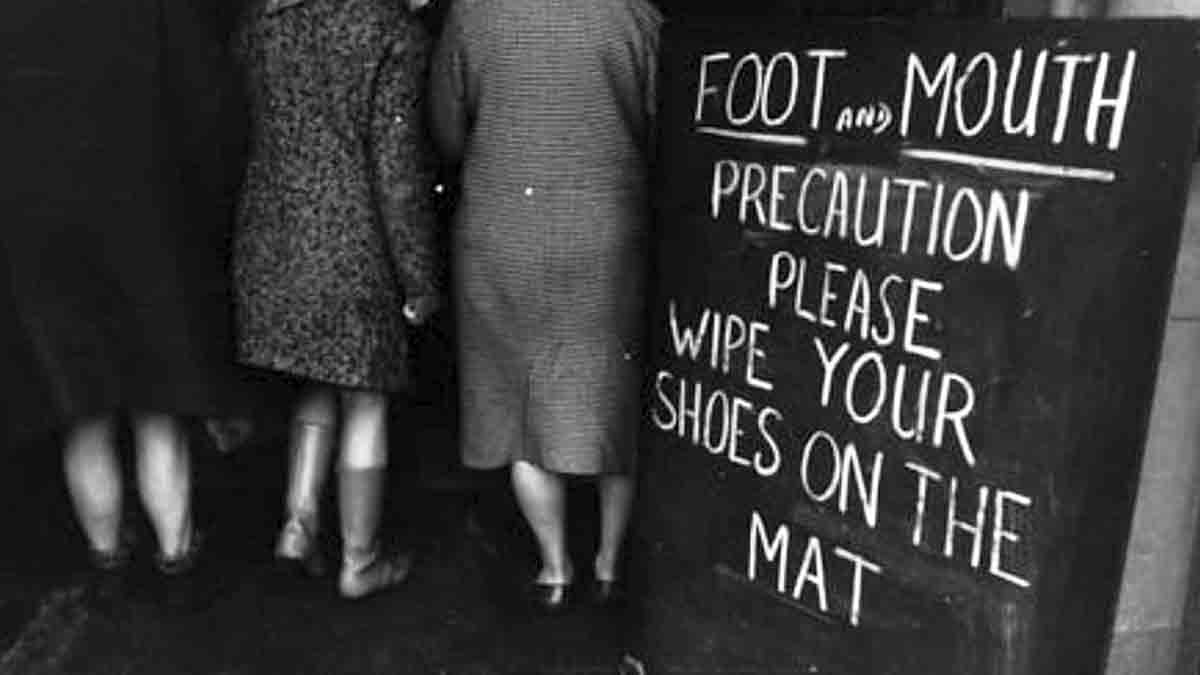
Movement between farms was restricted, and all fairs, markets, and sporting fixtures deferred. Farmers were obliged to place containers of disinfectant at entrances to their lands. Any caller that failed to dip his or her feet in one of these troughs got a severe telling-off.
At Callan creamery, similar precautions were enforced, with carts containing churns of milk, and the horses or donkeys pulling them, having to pass through hastily installed canals full of disinfectant.
Outside the entrances to the Parish and Friary churches, special mats were laid for worshippers to tread upon on their way in to pray. Local wits spoke of having to cleanse their soles before going to mass, but many people complained that the churches reeked of disinfectant.
At one juncture, the congregation noticed with a mixture of surprise and hilarity that a priest was wearing Wellingtons as he celebrated Mass. Some of the younger “worshippers” had difficulty keeping straight faces when their spiritual mentor plodded about awkwardly at communion time in the shining black wet Wellingtons that reached up to his knees.
A local beekeeper claimed to have positioned tiny mats in front of the entrances to his hives and that he had trained the bees to wipe their feet on these before entering or flying out of their little abodes.
Sean Holden (Callan’s youngest LDF volunteer and future acclaimed community activist) was invited by the beekeeper to witness this impressive instance of disease prevention through a magnifying glass.
In an interview I conducted with him in the Cosy Inn pub in 2002, Sean confirmed that the two or three bees he observed at the hive entrance did appear to be disinfecting themselves in accordance with Department Regulations…
(Extract from my book Are We Invaded Yet?)
To be continued…