


 By Ger Cody
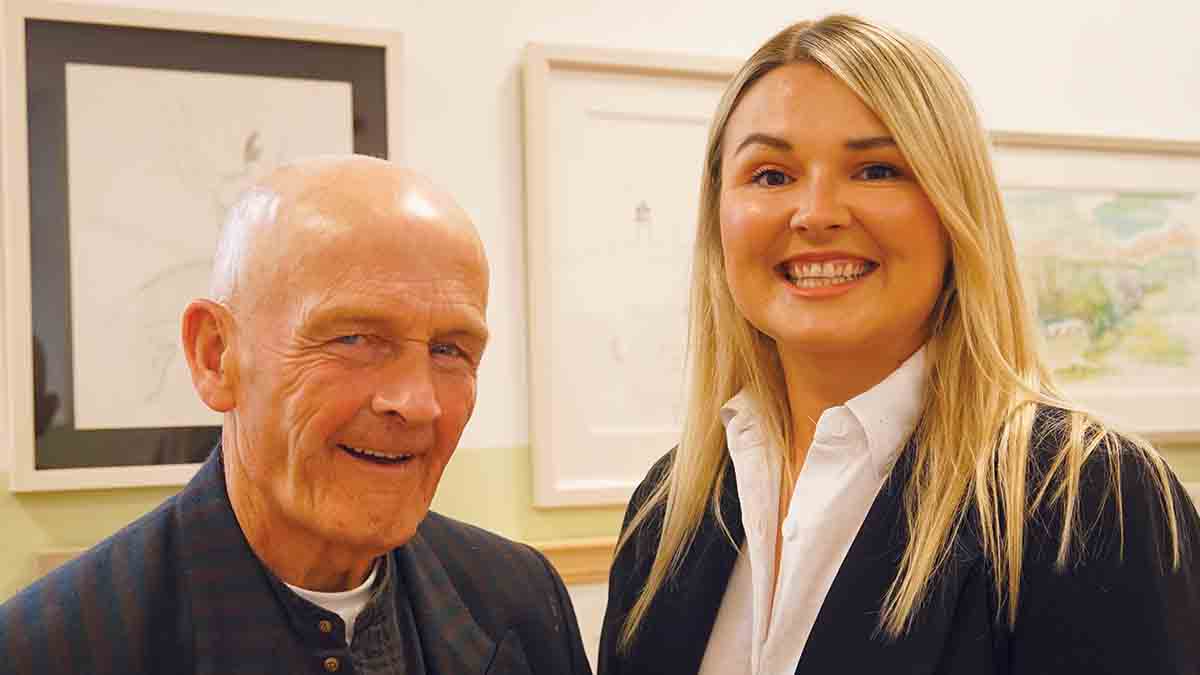
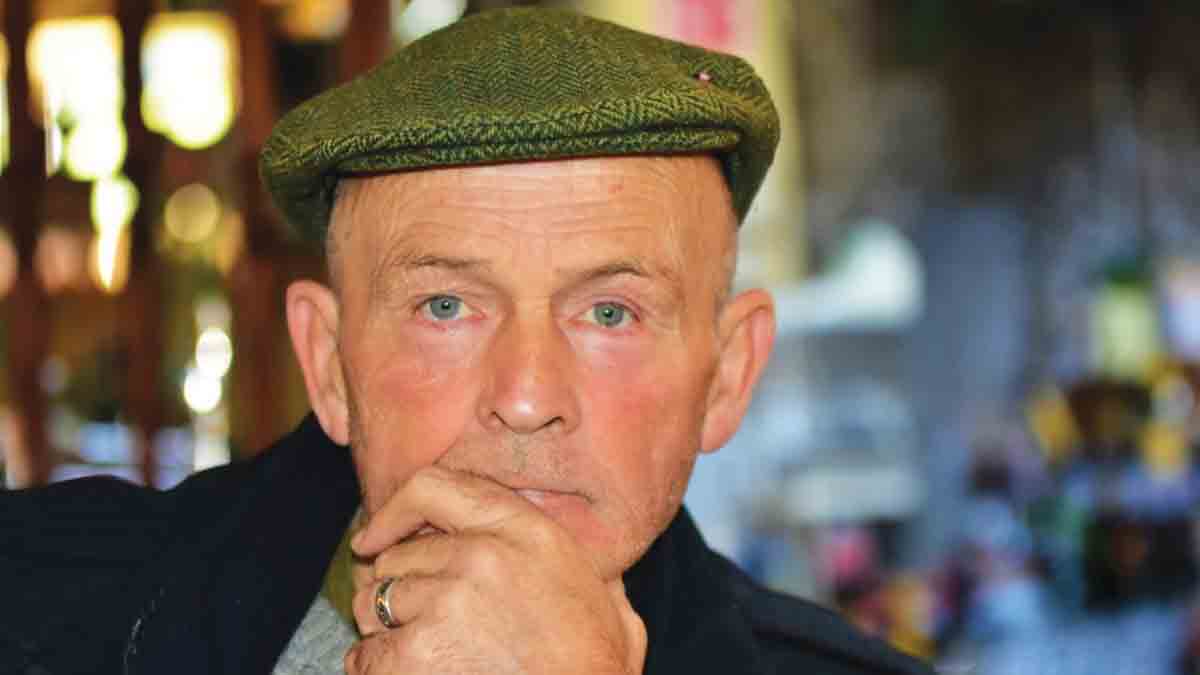
Last Saturday, I called to the house of artist Davy Holohan for a chat. He is preparing for his art exhibition at the St Canice’s Neighbourhood Hall on the Butts Green in August.
One thing about Davy is that he has his priorities right. Although anxious to explain about his forthcoming art exhibition, we spend the first 20 minutes discussing the forthcoming wedding of his daughter Shauna. Two mugs of Barry’s tea (complemented by the finest barmbrack) later, he is still talking about the pride he has for his daughter. Speaking of his daughter Shauna’s pragmatic decision to forego her artistic leanings to pursue a career in accountancy, Daithí’s smile breaks into a laugh “If the art is strong it will find a way- but I just want her to be happy.”
Observing Daithí over the years I watched as gallantly he battled and subdued destructive demons. I watched his committed political position almost ignored. I watched him produce a succession of authentic work that brought him much satisfaction and little reward. Through all the trials and tribulation, through all the praise and acclaim, I wonder did Daithí ever know happiness. As he speaks once more of his daughter Shauna, the austere persona relaxes and his smile radiates. Comprehension dawns! Shauna is what makes him happy.
Eclipsed
In September 2022, playwright, poet and artist Patricia Burke Brogan died. I can’t say I knew the lady, but I was a great admirer of her work and in particular her play Eclipsed, which I had the pleasure of seeing in her home town of Galway back in 1992.
She played a crucial role in exposing the hidden reality of the Magdalene Laundries. Her successful 1992 play, Eclipsed, was based on her experience as a novice in the order of the Sisters of Mercy. She worked in the 1960s at a Magdalene Laundry with women who were mainly viewed as having breached the rules of an ultra-conservative Ireland that was dominated by a traditionalist Catholic Church at the time. The Magdalene institutions started out initially in the 18th century as Protestant asylums for ‘fallen women’ who had given birth to children without being married. They existed on both sides of the Irish Sea in the 19th century, but survived much longer in Ireland where they were taken over by the Catholic Church and turned into laundries for the clergy and for commercial clients, with the women working for no payment. Many of them were unmarried mothers who were removed from their babies and placed in the institutions, mostly with the approval of their own families, who were terrified of the ‘scandal’. In some cases, they were put away simply on the basis that they might become engaged in sex outside marriage.
Elements of the Irish state system colluded in the process, and the final laundry was not closed until 1996. A total of 11,000 women had worked in them since the foundation of the State in 1922. Motivated by concern for the poor and underprivileged, Patricia became a novice and was sent for a short time at the age of 21 to the Magdalene Laundry on Galway’s Forster Street, which closed in 1984. The building was demolished in 1991. A burial ground for the Magdalene women is located on the grounds. She later recalled the deafening noise of laundry machines in a place that felt like hell on Earth. The result was that she decided a nun’s life was not for her and left the order.
Her bravery, her ‘stickability’ to the truth blew me away. When I brought the play to the Watergate in the early 90s it certainly caused controversy and I still recall the shock and sheer fright from a packed hall when the Magdalene story was told. In a foreword to her memoir, President Michael D. Higgins recalled he first encountered Patricia at a meeting in Galway city in the 1960s to discuss setting up a branch of an organisation called Tuairim (Opinion), whose objectives included promoting music and art. He was impressed with her abstract paintings, and continued “Her first stage play, Eclipsed, changed everything. A play that was as faithful to the lives its characters represented, as it was to the hidden stories.”
And it is with Patricia Brogan Kennedy that I draw the comparison with Kilkenny man Davy Holohan.
Numerous risks
Like Brogan Kennedy, Davy has taken numerous risks and with these risks he too has encountered grief and torment, albeit at times sheer jubilation when his mind and body gave permission to do so.
He is a man I have known for the best part of sixty years. We shared a friendship throughout those years and though our political affiliations may have differed, our mutual friendship meant there was always healthy discussion and never arguments.
Consistency
“In spite of everything I will rise again: I will take up my pencil, which I have forsaken in my great discouragement, and I will go on with my drawing.”
These words of Vincent Van Gogh echo across the years, showing the consistency of the artistic temperament, and today they encapsulate the life of Daithí Holohan.
A son of Peig O’Brien from Greenshill and of Johnstown’s Eddie Holohan, Daithí has a wide and varied CV. Having attended Kilkenny CBS primary and secondary school he made his first foray into employment as an apprentice goldsmith with Rudolf Heltzel. Traditional values resonated and he spent a year in Connemara studying Gaelic language and culture. He did a pre-diploma course in the National College of Art and Design and then completed his studies in the Fine Art Department under the guidance of faculty head Campbell Bruce. He was awarded a scholarship to Minneapolis College of Art and Design. He taught Life Drawing in Liberties Vocational School. Daithí’s community spirit saw him actively involved in mural projects in Bishop Birch Place, Millennium Court and Loughboy Library. His involvement as Artist in Residence with Kilkenny Collective for Arts Talent was a satisfying and an emotionally rewarding experience.
Daithí, often to his own detriment, is fully committed to his artistic endeavours. With a substantial body of work, recognised nationally and internationally, Daithí has established himself as one of Ireland’s great talents. Since the 1970s Daithí has successfully exhibited, bringing his creative pieces to the public.
I recently studied his catalogue of work and was amazed at the diversity of his art.
His still life Pipe Scissors Plant 1985 is a simple production and to me tells the story of a man carefully tending his favourite pot plant. But a friend viewing it saw a woman wistfully tidying the house the morning of her husband’s death. This is one of Daithí’s strengths; he allows your imagination to flourish.
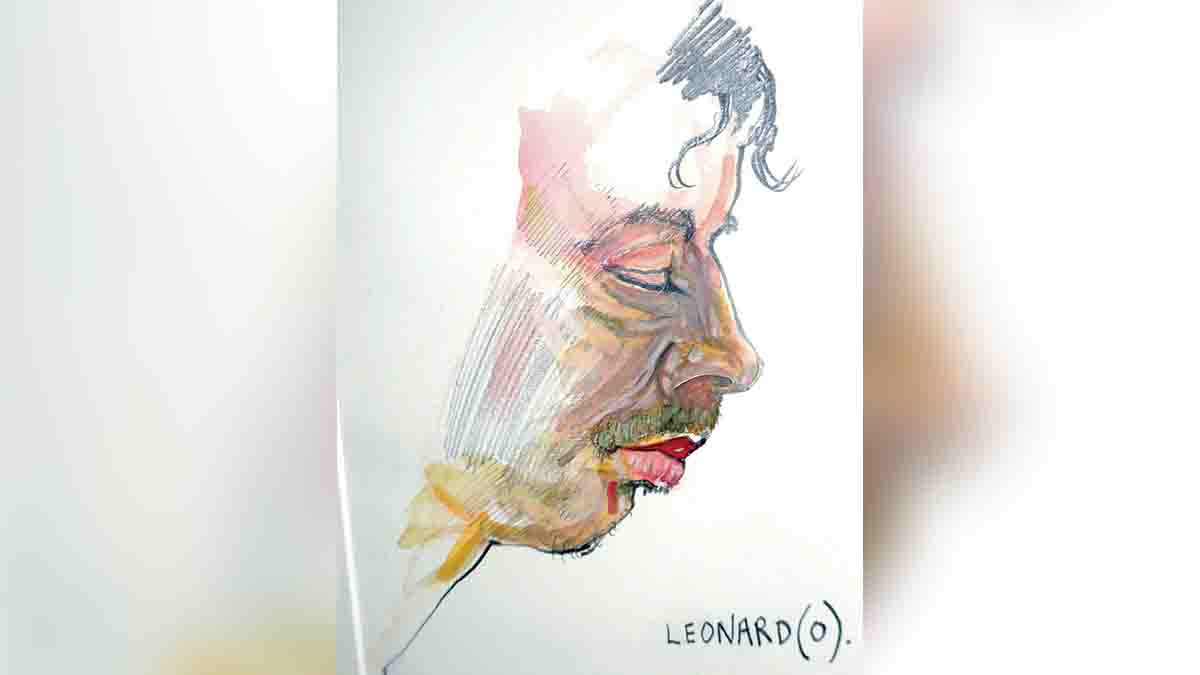
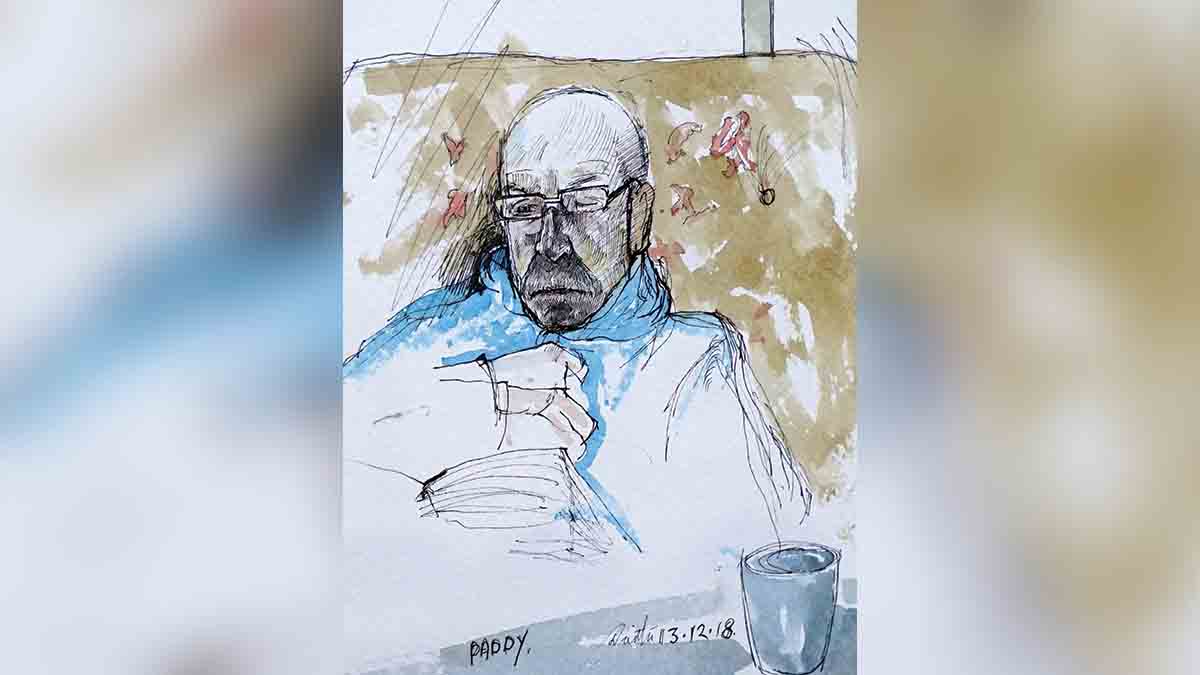
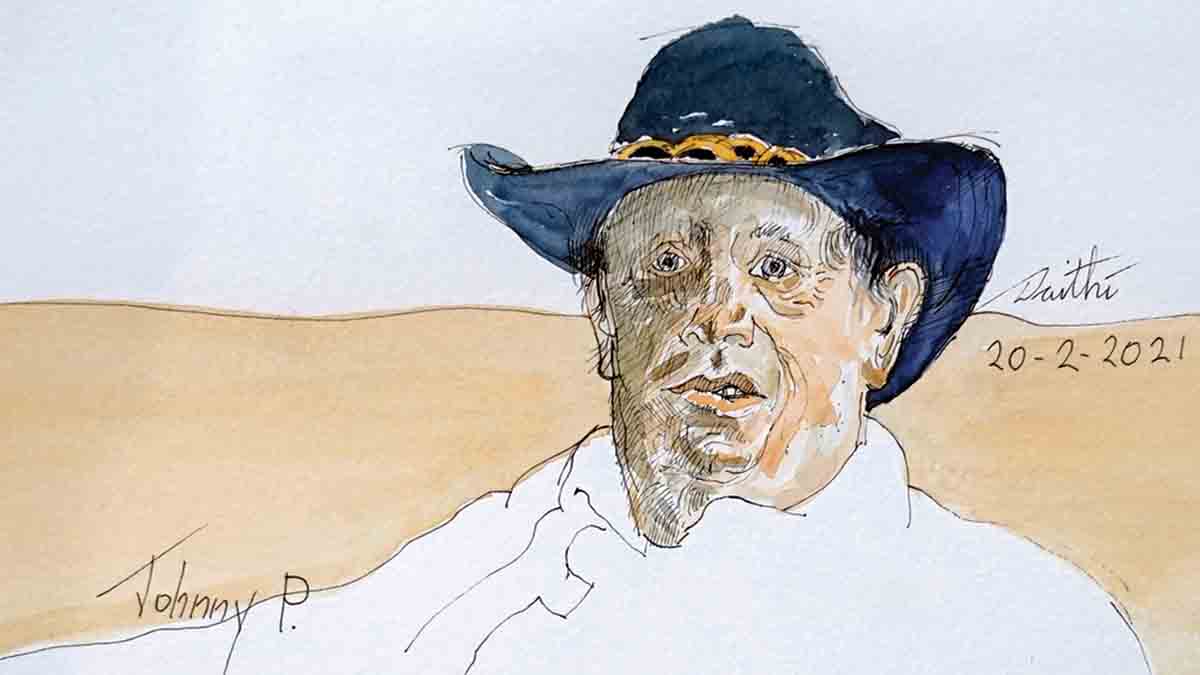
As a portrait artist Daithí is exemplary, and is perhaps its foremost exponent. Daithí treats his subjects with humanity and yet there is a depth and subtlety to be observed. Kathleen 1994 emits calmness, thoughtfulness, and serenity. Shauna 2009 exudes love, innocence and hope. But in his self portraits Daithí bares his soul. Through his introspection he facilitates our intrusive inspection. The surreal images reveal the elemental battle of a tortured psyche. These portraits haunted me, fascinated me. Their honesty demands our reflective respect. Perusing Daithí’s work, I am reminded of one of Patrick Kavanagh’s short poems:
No charlatan am I
With poet’s mouth and idiot’s eye:
I may not be divine
But what is mine is mine
In naked honesty.
Of late, Daithí’s work has become more fluid and this allows a vibrant intensity to explode from his canvas. No longer confined to a single form, the freedom engendered is celebrated in his enthusiastic labours. As he ages has Daithí settled into a calm controlled individual? I hope not! I agree with Fredrick Nietzsche who said “You must have chaos within you to create a dancing star.” With over a thousand drawings in his portfolio, Daithí has bequeathed a galaxy of dancing stars for our discernment and enjoyment.
I know first hand the trials of Davy as an artist. To have suffered for his art is apt with this man, and to recognise that suffering for art is his future also, one can only sit back in awe and admire this man.
The French novelist Emile Zola could perhaps have been speaking of Daithí Holohan when he said “If you ask me what I came to do in this world, I, an artist, will answer you. I am here to speak out loud.”
Daithí Holohan’s voice reverberates across the land and those of us living at this time are indeed fortunate to witness his genius.
Daithí Holohan’s exhibition will take place at St Canice’s Community Hall on August 7 at 7pm.