


By John Fitzgerald

(Part four)
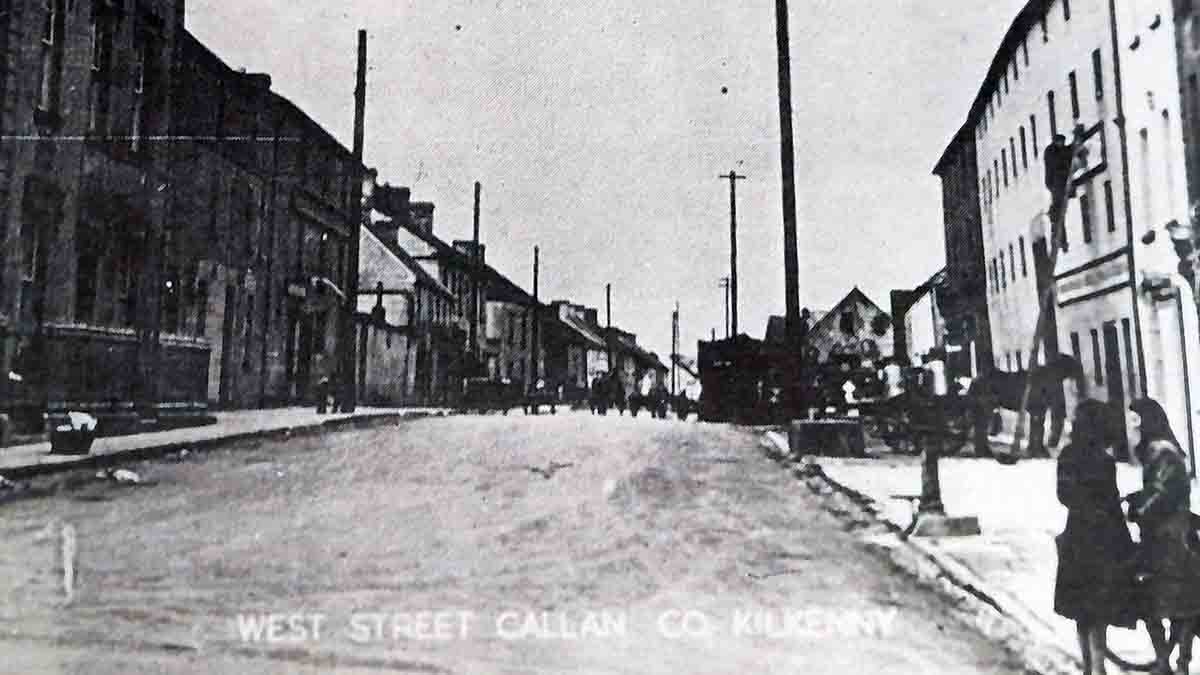
(Carmel Kealy’s recollections of life in early 20th century Callan provide a fascinating insight for people of present and future generations. Part one, two and three can be read on the Observer website.)
Johnnie Roughan did odd jobs around the town and was fond of a jar. He was noted for his wit and always had a sharp cutting retort for anyone challenging his lifestyle. Even the Parish Priest came in for some well-aimed barbs. The PP felt that Johnnie had not taken his advice about temperance and he tried to corner his wayward parishioner whenever he got the chance to see if he could “put him off the drink”.
One evening, Johnnie stumbled out of a pub in Green Street and almost fell on top of the PP who was taking a stroll. “Drunk again Johnnie!” exclaimed the priest, as bemused locals stood on the pavement, waiting for the inevitable response, but wondering if, for once, their comical friend was lost for words.
As Johnnie straightened himself up, the PP looked around at the crowd gathering outside the pub, coughed delicately, and repeated, louder this time: “DRUNK AGAIN JOHNNIE!”
Johnnie looked at the PP, winked, and shouted: “Be God, so am I, Father!” Unhappy with this attitude, the PP again confronted Johnnie a week later. “Johnnie, drink is not the answer to life’s problems. Don’t you know, man, that Christ died to save you and me from the drink, among other vices? Don’t you know that he died on the cross?”
“I missed it all”, replied Johnnie, “sure it was up by Newmarket Lane I came. Saw nothing.”
Paude Marnell kept a variety of exotic talking birds outside his front door. One evening, after he discovered that Callan’s pump had gone dry, he filled a dozen jam jars full of holy water from the Church and the birds happily sipped it to quench their thirst.
Next morning, according to Paude, the budgies and canaries were singing “Faith of Our Fathers”, a hymn he had never taught them. The clergy, though, refused to acknowledge the “miraculous” nature of this achievement.
“Skid Away” Carroll was another familiar face around Callan in the pre-World War One days. Like many locals before and since, he met friends at the Cross-to hear, or pass on, the latest gossip. He did repair work on the handful of motorcars in the locality.
“Skid Away”, of Mill Lane, also made a decent enough living from the sale of firewood around the town and countryside. His old saw could be heard humming day and night as it sliced through ash, oak, poplar, or any other timber that came his way.
He liked commenting on people who walked past him at the Cross-, dissecting his or her alleged weak points or drawbacks and recommending, to no one in particular, the supposed remedies to “cure” them.
He was fond of threatening to convert to Protestantism whenever he wished to highlight unsavoury behaviour among his peers. This remark never cut much ice: He seldom went to Mass himself anyway, which somewhat blunted his warning.
When the troubles came to Callan, “Skid Away” opted for neutrality and Carmel joined Cumann na mBan.
Eddie McMaster, the “Good Tan” lived at Skeaugh, outside Callan, during the Free State era. He was so-called owing to his brave behind the scenes co-operation with the IRA in Callan.
Though he was sent over to Ireland as a ruthless Black and Tan to suppress the freedom movement, he got to like the Irish ways, and Callan pub life in particular, and decided to tip off the Flying Columns in the area about the movements of police and occupation forces.
Eddie’s pronounced English accent gave him an air of authority and gravitas as he deliberated on the political situation or batted the breeze in a pub.
Jack the Hearse was another memorable character. Jack had more than a passing interest in the afterlife. A local man, he attended every funeral in the town regardless of who was being mourned. He knew everybody.
He made himself conspicuous by sitting up beside the driver of the hearse, dressed in black, though he had no connection with the funeral service. The driver welcomed his company and valued Jack’s observations on the life and times of the dearly departed.
Carmel remembered an old gentleman whose attention was also fixated on the next world. He operated a mill at the end of Mill Street: She described him as “a grand old gentleman, tall and stately looking, with a long white beard.” In his spare time, he composed poetry. A son of his was a priest in Mount Mellory, while a second son, Dick, was an accomplished step dancer who played the violin.
Carmel held on to one of his poems. It went:
When the miller leaves the mill
And the dripping wheels are still
When at night this humble heart prays fervently
Lord when life’s short round is o’er
And my heart shall beat no more
Grant that with Thee I may rest eternally.
Carmel Kealy died peacefully at St. Columba’s hospital, Thomastown in May 2003. In addition to paying tribute to her family, who cared deeply for her, I want to finish this article by mentioning Marianne Kelly (nee Lyons), who was one of those dedicated people who looked after Carmel in her final months of earthly life. She tells me that the Callan woman- her friend- remained “strong and resolute” to the last; right up to the moment she passed to a better and happier world.
Marianne is well known for her involvement with the Kilkenny Heritage Walkers and the Gospel Choir. She’s delighted that Carmel left behind the treasure of her memories; a part of Callan’s heritage that will be valued and appreciated by future generations.