


By John Fitzgerald

The Kilkenny Heritage Walkers have been time travelling again. Ailbhe Fitzgerald’s presentation on the cultural significance of the Butler Gallery and the Kilkenny Design Workshops drew sighs of admiration.
Ailbhe displayed a superb academic flair and an uncanny grasp of historical detail as she rhapsodized about the contribution of the Gallery and Design Workshops to the social fabric and celebrated artistic life of Kilkenny.
A week earlier, the walking group had its annual tour of the Christmas cribs. Marianne Kelly brought her renowned spiritual insights and extensive knowledge of the city’s religious heritage to bear as she painted evocative word pictures. She stood in front of each likeness of the original crib in Bethlehem and as you listened to her eloquent address, you could visualize Jesus, the Wise Men, the humble farm livestock, and the seraphic beings who watched over all.
But the walkers were really “blown away” by historian Paddy Neary’s talk and tour. With his usual penchant for detail and dramatic pathos, he told the story of a night long ago when the county was caught up in a weather emergency…one so frightening that Kilkenny folk feared the End of The World.
You almost forgot you were standing in temperatures of two or three degrees below zero when you listened to Paddy recount what happened locally on Ireland’s Night of the Big Wind.
On January 6th 1839, the country experienced one of its greatest ever natural disasters when a windstorm of exceptional severity sweeps the whole island.
It was a surprise attack by nature on the pre-famine population of eight million, many of whom were joyously looking forward to the celebration of Little Christmas.
The day before, heavy snowfall had carpeted the country, a rare enough weather event in itself. Next day, an Atlantic Warm Front arrived to melt the snow. Then came the rain and the wind began to rise to hurricane force.
By ten o’ clock, the elements ravaged Ireland as never before in the memory of anyone living at the time.
Homes and other buildings were damaged and lightly built structures swept away in the storm. Collapsing chimneys sparked fires.
At least 213 people died countrywide and an estimated 200 ships were cut loose from their moorings.
The fatalities included fishermen whose craft was lashed mercilessly by the wind. In some coastal areas, waves rose to unprecedented heights.
Paddy Neary recalled that Kilkenny’s local media reported on the worst storm ever to engulf the city. He guided the walkers to the main impact sites around Kilkenny, bringing to life the stranger than fiction events of a night that has passed into national folklore.
In reverential tones, the papers claimed that the first sign of the approaching freak of nature was the eerie soughing and whistling of the wind and a sudden citywide series of sharp crashing sounds as slates were dislodged from roofs.
Houses started rocking as if they were made of matchsticks. Terrified householders hid under their beds or took to praying. Roofs were sheared off and some houses were allegedly blown along streets with petrified families still huddling inside.
The papers stated that people in Church Lane, Green’s Bridge, Mill Lane, and Barrack Street looked up to find the roofs gone from their houses, as if a giant had huffed and puffed and made them disappear.
Prominent public buildings also took a hit. Dozens of windows were shattered, including those of the historic Tholsel. The storm spared no house in the city as it wrenched tiles, bricks and slates from roofs or walls that crashed into other buildings.
Not even the residence of the Bishop, opposite Troy’s Gate, escaped the Big Wind. It knocked the garden wall of his Palace and bricks from it landed far along Green Street.
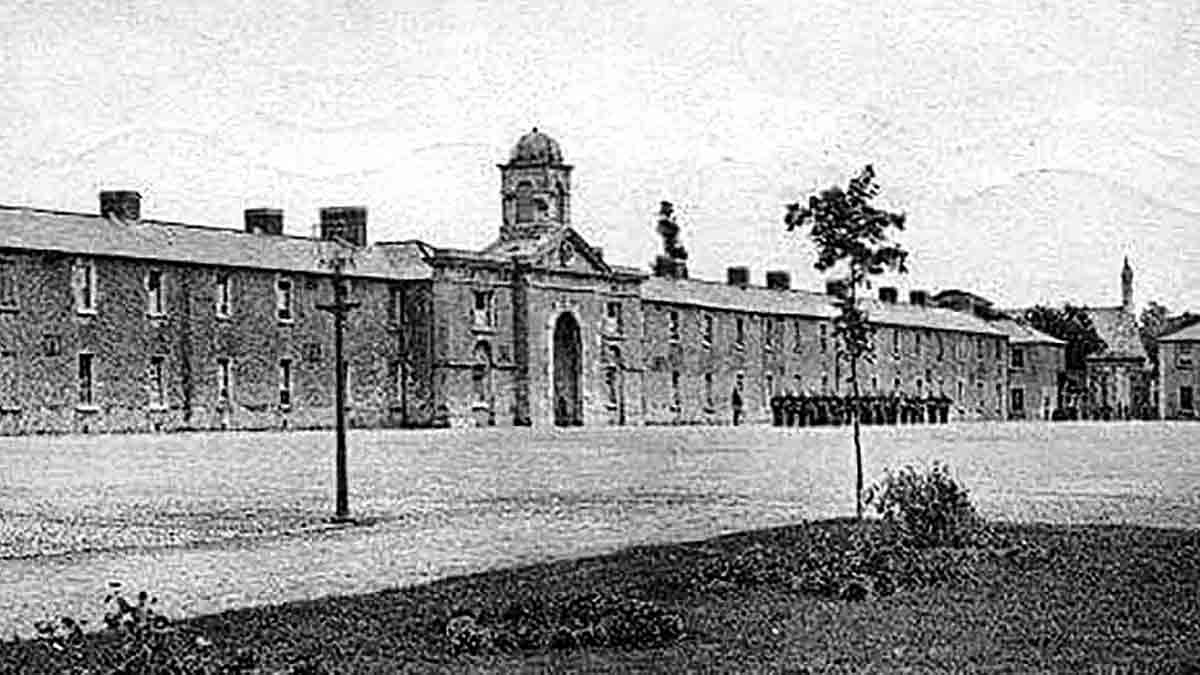
It struck the Military Barracks too. Local patriots later speculated that the carrying away of the British crown motif over the arch leading into the inner square might have been a foreshadowing of seismic political change to come.
Symbolically, they felt, it might have heralded the departure of the British Army from the barracks, and from Kilkenny itself, in the following century.
St Canice’s Cathedral escaped lightly enough, but a cross was broken on the Western window and a weathercock bent out of shape. Solid stone ornaments at St Canice’s Catholic church were broken, including a much-loved cross.
The one-hundred foot high chimney of the Gas House came crashing down: Part of it narrowly missed a man standing inside the gas works as it hurtled down through the roof.
The storm sparked fires in parts of the city and the Tholsel Bell faithfully rang out to alert citizens.
As with all disasters, the storm also brought out the good in people. A Rev. Sandys gave shelter to some families whose homes were destroyed, offering them food and money to tide them over their misfortune.
And it wasn’t just buildings in the city that felt the impact of nature’s wrath. The storm uprooted trees on the Parade and along the Canal Walk.
It was the same story outside the city. Small cabins were cast aside as if an invisible hand had swiped them, and some hardy men lay across their thatched roofs to prevent the wind from taking them off. Their wives handed up food and tea to them where practicable as they clung to their precious roofs. With the wind howling ferociously, it was a struggle to keep their homes intact. Haystacks on farms were easy prey for the wind, and livestock went hungry as a result.
A glass house at Jenkinstown was seen sailing eerily over a ten-foot-high wall and smashing into trees, and on the Jenkinstown demesne an estimated 450 trees were uprooted.
At Castlecomer Mr. Wandesforde’s greenhouse was wrecked and he was shocked to find many of his trees ripped up.
There was a belief at the time that Judgment day would coincide with the Feast of the Epiphany, January 6th, which added to the panic and fear that swept the county.
Relief descended like a blessing from above when the storm abated. The full scale of the devastation became apparent as people ventured out of doors again. They offered prayers of thanksgiving that, although there were numerous injuries, at least nobody had died in the storm locally, unlike in other parts of Ireland.
Then came the big clean-up, and, naturally, carpenters and builders cleaned-up financially, with a huge demand for repairs and rebuilding countywide.
Decades later, the storm was still making the news, apart from being vivid in the minds of anyone who experienced it. When the Old Age Pensions Act became law in 1908, one of the questions asked as proof of age was, “do you personally remember the Night of the Big Wind!”
The next outing for the Kilkenny Heritage Walkers will be in Callan, on Saturday January 17th, where Liam Burke will recount the story of the old Augustinian Abbey and the historic Norman Motte, better known locally as the Moat.