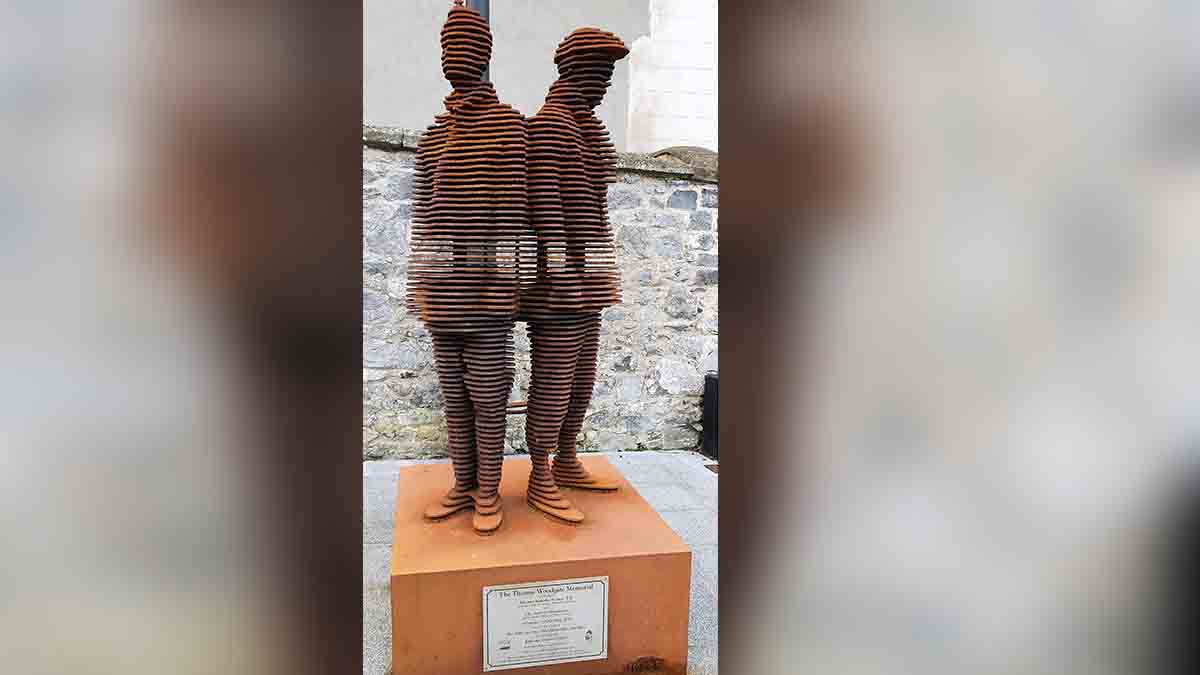



Possibly one of the sculptures that attracts most attention in Kilkenny city is that of Thomas
Woodgate, which is situated outside The Kilkenny Courthouse at the Market Yard.
Constructed by Kilkenny Company Stapleton Engineering, the story behind the monument is intriguing. It is the story of Thomas Woodgate. A boy of 14, killed in the final weeks of World War I, and commemorated with a public sculpture in Kilkenny. Thomas Woodgate duped recruiting officers by claiming he was 18 and enlisted in the Royal Air Force on September 19, 1918. He left his home in Mill Street in Callan, Co Kilkenny, to begin a journey to join his training squadron in Egypt. He sailed on the RMS Leinster steamship from Dún Laoghaire, then known as Kingstown, on October 10. However, shortly after leaving the harbour, a German submarine attacked the ship with torpedoes and sank it. The Irish boy was one of 569 men, women and children who lost their lives in the attack.
Over the last week, Michael McFarland Campbell visited Kilkenny and was very taken with the Woodgate monument. He said as much in a letter to the members of the WW1 memorial committee. In his letter to Donal Croghan, he told the committee that having seen the monument he was inspired to write a poem titled ‘Rust remembers’. Mr McFarland Cambell said that although he had visited the city of Kilkenny on many occasions this was his first time to take time out at the Woodgate memorial. Speaking to The Kilkenny Observer, Michael said the sculpture’s weathered, incomplete form and the powerful use of negative space deeply struck him. “Learning the history behind fourteen-year-old Thomas—and reflecting on how the monument honours both his individual memory and the broader, often quiet grief surrounding Ireland’s role in the Great War—led me to sit down and write this piece”, said Michael.
Having learned about the committee’s dedication in bringing this monument to fruition alongside CDS Architectural Metalwork and Stapleton Engineering, Michael wanted to pass the poem along as a small gesture of appreciation for the work.
Rust Remembers
For Thomas Woodgate, a fourteen-year-old boy from Callan
I am not bronze. I will not shine.
The rain has had its way.
I wear the colour of the fields
In winter after hay.
Look closer. I am made of gaps,
Of spaces left unfilled;
Like stories spoken half aloud,
Like names no stone has held.
Through me the light of Callan falls,
The traffic hums nearby;
Schoolchildren pass with headphones on
Beneath September sky.
I stand for Thomas. Fourteen years.
A child by any measure.
The sort who should have lost his days
To fishing, games, leisure.
Instead the sea closed overhead,
The Leinster went below;
And everything he might have been
Sank with him in its flow.
Yet I am more than one young life.
I carry others too:
The farm boys from the Barrow lands,
The lads the Suir once knew.
The girls who nursed through blood and smoke,
The men who crossed the foam;
The ones who came with altered hearts,
And those who came ne’er home.
For Ireland learned to lower her voice
When speaking of that war.
Some memories were left outside,
Some never crossed the door.
Too British, some would sometimes say;
Too Irish, others thought.
While grief sat silent at the fire
For sons the island lost.
But rust remembers differently.
I do not choose a side.
The sea receives the rich and poor,
The foolish and the wise.
So stand a moment if you wish.
The town moves on. It should.
The dead ask little from the living,
Only to be understood.
And when the evening settles down
On stone and slate and spire,
You may see through my broken shape
The ghost of a vanished choir.
Not singing of old victory,
Nor empire, crown, or throne;
Only the young of Ireland lost,
And how they come on home.
(— Michael McFarland Campbell)