


By John Fitzgerald

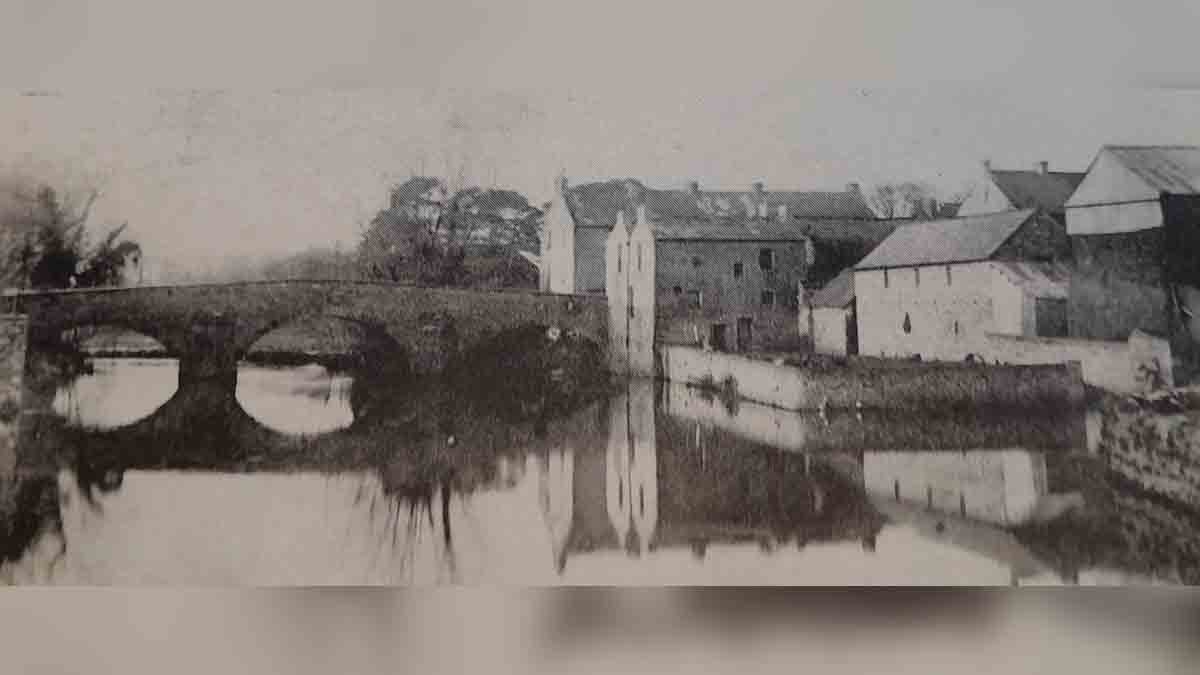
Looking over the Big Bridge in Callan today, you can admire the scenic beauty of the Moat, or the rolling green sward of the historic meadow.
But you won’t see a single boat navigating the serene or choppy waters of the King’s River. How different from the scene that would have greeted an onlooker from the same vantage point in the early decades of the twentieth century.
Local newspaper correspondent Peter Roughan recalled a time when boats of all shapes and sizes sailed or sped along the surface of the Calm Avonree. This was mainly in the first two decades of the century.
He observed that the ‘navigation logs’ of Callan showed long voyages from Ivy Lodge to Katie Cass’s orchard. He noted: “There were some lovely apple wharves in between: Ivy Lodge in the extreme north, then Hayden’s below the Turning Hole, Mrs. Martin’s below the Lane, the Friar’s next, and below that we had Dr. Shee’s, and the last post of all was Cass’s.”
When Jimmy Somers bought the Adelphi Hotel, he noticed a reference to local man Tommy Walsh in the Title Deeds. Tommy had been one of Callan’s Ancient Mariners. Jimmy had acquired “a house with two bars”, according to Peter Roughan. The second bar was situated behind the old dispensary.
A garden gate opened on to a few steps that led to the river, where Tommy kept his flat-bottomed boat tied up. Though he treasured his worthy vessel, Tommy complained that he rarely had enough “high water” at the Adelphi Bar to give the boat a proper send-off.
On Sunday evenings, he sailed as far as Katie Cass’s orchard. He rarely ventured further, and used to joke that while he liked eating baker’s bread, he was a bit nervous of Baker’s Weir.
Before Tommy Walsh, Johnny Maher had also caught the nautical craze. His boat was one of the first to take to the water, in about 1905. Johnny had his vessel anchored on the South Side of the bridge, opposite to where Tommy’ boat lay at rest in later years.
When not on active service, the boat could be found bobbing in the water at the bottom of the stone steps leading down to the river. The steps were part of the Bridge House property.
There was an iron gate at the top of this little stone stairway. Johnny Maher invited locals to come sailing and “View Callan from the river”, always a happy prospect in those quiet days before motorised traffic.
In later years, Vincent Lanigan opened a jetty for business at the end of Clothiers Lane, at the steppingstones. He berthed his “liner” there, as he called it. His boat had seen service on the River Suir near Carrick.
What came to be known as “Lanigan’s Wharf” was ideal for the purpose, Vincent explained, as it was easy to haul the boat on to dry land, and yet leave adequate space for James Nolan’s horse and cart to get past with barrels of water for the steam engine in the saw mills of West Street.
Vincent relied on scores of bare-footed helpers to push his boat into deep water between the land and Friary Bridge. After that, it was plain sailing all the way for “Captain Lanigan”.
Peter Roughan also wrote of Callan’s “Three men in a boat”: Bob Townsend, Joe McLean, and Josie Mahoney, who all lived in Bridge Street. They launched a craft called the Old Glory on the river.
They shared the berthing facilities on Clothier’s Lane with other boats. This boat was the pride of Callan, and the adventurous trio boasted that it was the last word in comfort, better in many respects, they claimed, than the Queen Mary.
Joe was the navigator, Josie the oar man, and Bob served as tour guide on river trips organised for the locals and visitors to town. He pointed out the various places of interest between the wharf and Baker’s Mill, which was as far as the craft could safely venture.
Whenever the boat set out on Sunday evenings, the lads had to be sure to have it back in dock in time for the weekly meeting of the Holy Family group in the Big Chapel.
One Indian summer’s day in 1912, the Old Glory almost came to grief against a boulder in the river. Bob and the two Joes, to settle a bet, had decided to explore some of Callan’s uncharted waters. The brave trio had to splash into the river, and work hard for several hours to manhandle the boat over the obstructing rock.
The boat sailed on, and the lads were full of cheer, their soggy clothes drying under a blazing sun. They cruised at a leisurely pace by the hospital field, past the workhouse septic tank, and neatly rounded Poulshawn, before moving in the direction of Cahill’s Flats. Josie Mahony’s skill as an oarsman was unequalled in Callan.
But there was more trouble ahead. Shortly after passing the Flats, the Old Glory nose-dived into a mud-bank on the north side of the river at the “Little Osiery”. The mariners had to abandon ship and get the craft on to dry land. Once ashore, they had to push and drag the boat overland to Mahony’s shed at Goatsbridge.
Next morning, the lads arranged for the boat to be transported back to “dry-dock” at the bottom of Clothiers Lane.
The Butler brothers of Minauns also had a boat on the river. William (later Colonel Butler) and Joe were an adventurous pair who loved taking to the water.
The nearest “shipping yard” to Callan was, it seems, at James Cahill’s of Kilbricken. The three Cahills, Jack, Tom, and Ned built a boat, ably assisted in its construction by their nephew, Dottie Stapleton, who doubled up as designer and gaffer in the “yard.”
The boat was a sturdy craft, made of staves and tarred canvas. It served its purpose well for a few weeks, until a few curious Callan lads turned up in the Kilbricken shipyard one day to see if the Cahills would let them have a trip in their boat. T.B. Cahill considered their request for a minute or two, and said heartily: “of course lads, we’ll take her out tomorrow.”
Tom Cahill and the Callan thrill seekers sat into the craft. T.B. joked that he felt like the “Admiral of the Fleet” as the boat sailed along the King’s River. His distinguished guests that day were Willie Joe Lanigan and the Pollard brothers, Dick and Jack.
But disaster struck when the boat’s canvass bottom was ripped apart by stones. The boat filled up with water and the four lads were forced to abandon ship. They had to leg it back to Callan, drenched to the skin.
As they ascended Baker’s Hill on their way into town, they had some harsh observations to make on the stricken vessel, the shipyard in Kilbricken, and the suitability or otherwise of the King’s River for pleasure cruises. Their exact comments have not been recorded.