


By John Fitzgerald

The Power House in Callan hosted a three-day exhibition of coins, old photographs, and artwork focusing on aspects of local history.
Retired farmer Philip Lynch, who mounted the display, is well known as a historian, raconteur, and teller of wonderful yarns, but he’s also a keen artist and a lifelong numismatist- or coin collector.
When I entered the exhibition hall, I was struck by the immensity of the collection of coinage, art and memorabilia. It covered every phase of Callan’s development as a town through the ages…starting with the story of how the King’s River got its name… the reputed drowning of an Irish Ard Ri in 844 AD after he tried to save a servant who had fallen into the raging torrent.
Philip’s oil painting of that alleged episode has the king mounted on horseback with sword raised, the floodwaters to his left and helmeted soldiers massed in the foreground.
He gave a lively commentary on each exhibit as visitors viewed an ambitious and tastefully arranged display that would take a whole day to appreciate fully.
He recalled the arrival of the Normans and the building of the famed Callan Motte- better known locally as the Moat, in a magical watercolour, offering bold depictions of how the Callan landscape looked in the 13th century.
Tullamaine graveyard near Callan also drew Philip’s scrutiny. His aerial view impression hints at the lost medieval church once located on the site, dedicated to St. Catherine, and the traces of an ancient street settlement. Philip explained that a medieval town almost certainly thrived next to the burial ground.
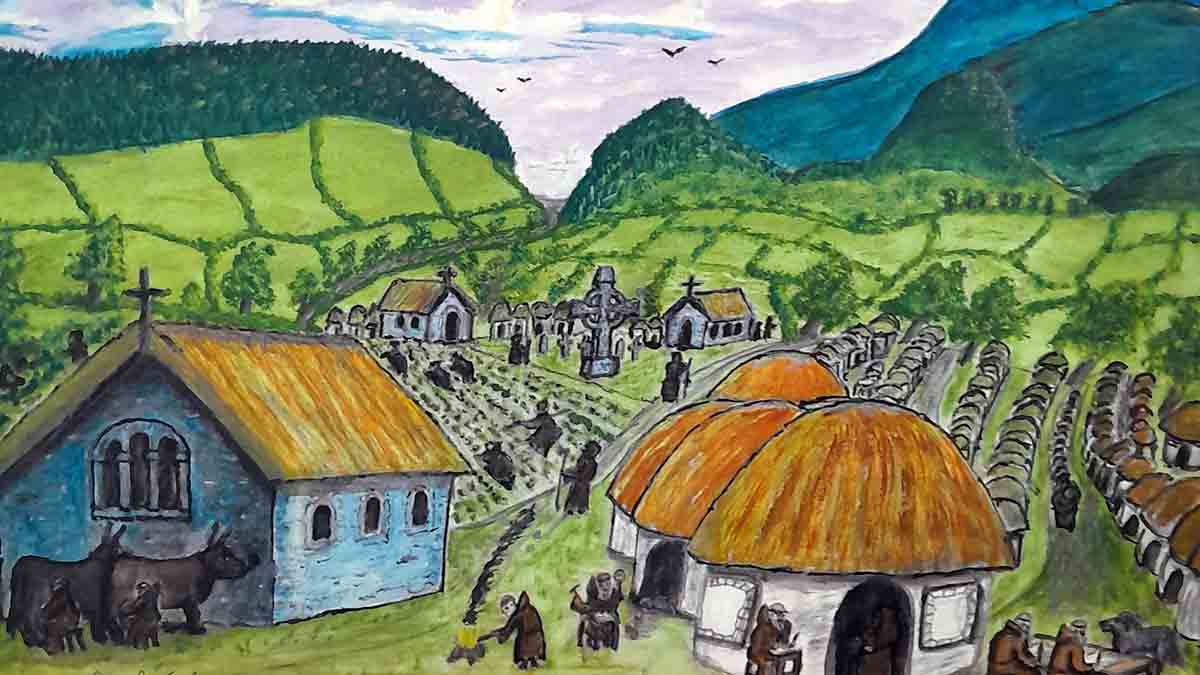
His painting of Killamery Monastery was among the most talked about works in the exhibition. It attempts to recreate the place of worship established in the seventh century by St. Gobhgan. Monks can be seen at work or at prayer, and the backdrop of rolling verdant countryside chimes with the nostalgic and evocative spiritual theme.
The painting inevitably has Killamery’s famed 9th century High Cross, with its intricate and ornate carvings and figures that inspired sculptors nationwide in their own fashioning of Celtic Crosses.
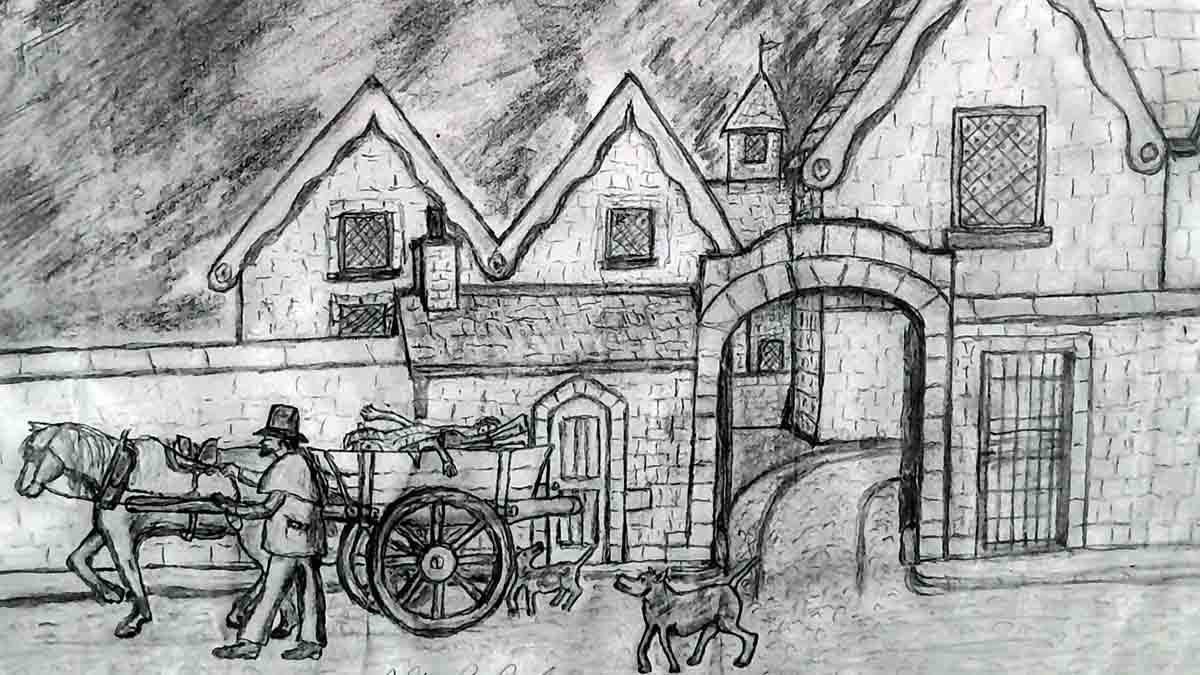
In a series of drawings, Philip recalls the dark days of famine in the locality. These works had visitors rapt. They stood contemplating bleak images of a time when people already reeling under the heel of tyranny and rampant evictions found themselves starving after the failure of the potato crop. Those Irishmen and women – our ancestors- were forced to either enter a workhouse or take their chances on one of the notorious emigrant vessels dubbed coffin ships.
One drawing showed a funeral cart leaving Callan Workhouse. Philip opted for monochrome in the famine drawings, as that age of horror, hunger and deprivation had, in a sense, been drained of colour. Charcoal seemed apt to recreate the grim scenes.
Another drawing depicted the abject poverty in which so many Irish people lived, even before famine loomed. Philip explained that families dwelt in hovels, while the landed gentry wined and dined in their big houses, or rode to hounds across a landscape strewn with the dead and dying, and roads lined with pleading families that the galloping overlords ignored.
Another subject close to Philip’s heart is the location and history of the mills that once stood along the course of the King’s River.
He showed paintings that brought to life those mighty powerhouses of the past.
Boland’s Mill, situated between Kells and Thomastown, endures. Despite showing the ravages of time, its five millstones survive, as does the old weigh bridge, and you can still see some of the tools used for the milling of grain
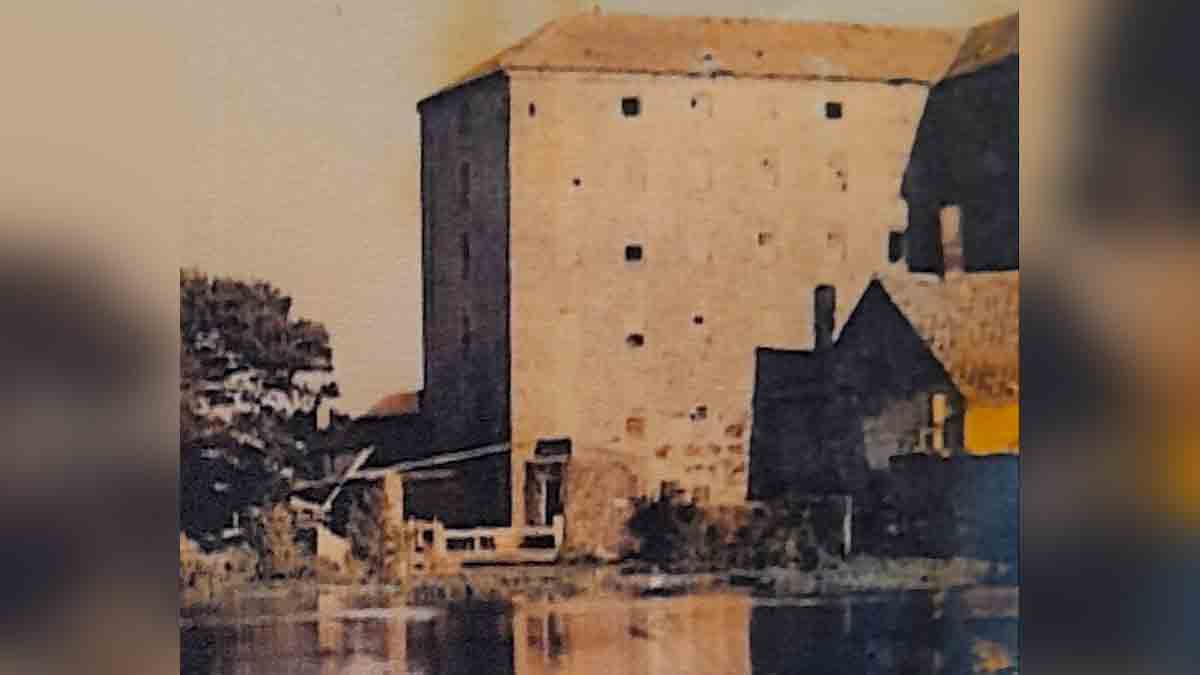
Somers Mill near Mallardstown, a seven-story stone and mortar structure with long narrow windows, was built in 1847. It functioned mainly as a corn and flourmill, and later produced animal feeds. It’s famous mainly because Ned Somers, who operated the mill for a while, died in the Civil War, while fighting on the Republican side.
Mullins’ Mill in Kells had supplied flour to the nearby priory since 1782, though an older mill built in 1204 had stood on the same ground. The later mill continued to operate until 1966, and the building now incorporates a lovely restaurant and a world-renowned visitor centre.
The Merino Mill near Stoneyford produced fine woolen cloth in the 1800s.
The artwork paid due homage to these heritage gems, among other mills in the county.
Philip’s coin collection was naturally a big hit. He has been collecting coins for as long as he can remember. What started as a minor hobby many moons ago became a passion and lifelong commitment.
At the exhibition he had examples of coinage dating to the Cromwellian era, and an image of the most hated man in Irish history greeted visitors when they looked down at the display case.
“There he is” Philip intoned gravely, “Old Copper Nose himself, who besieged Callan for three days in 1650 and left the town in ruins!”
He had coins too from the famine era (mainly showing Queen Victoria) but the most popular ones were what Philip called the “freedom coins.” The old pennies, shillings, and half crowns minted by the Free State government in 1922, and that remained in circulation until decimalization took over. The penny was there with the hen and her chicks, the halfpenny had a pig, the shilling a bull, and the half-crown a horse.
Philip sees coinage as a link to our ancestry. Holding a penny, he mused, “When I pick up one of these, I feel transported to other times and places…to that other country of the past.”
The Power House proved an ideal venue for the exhibition. What used to be a part of the old bacon factory is now a vibrant creative hub, famed throughout the South East for its commitment to art, theatre and ecology awareness events.