


By John Fitzgerald

(Part One)
Catholic clergy have, for centuries, wielded authority and given leadership in the social life of Callan.
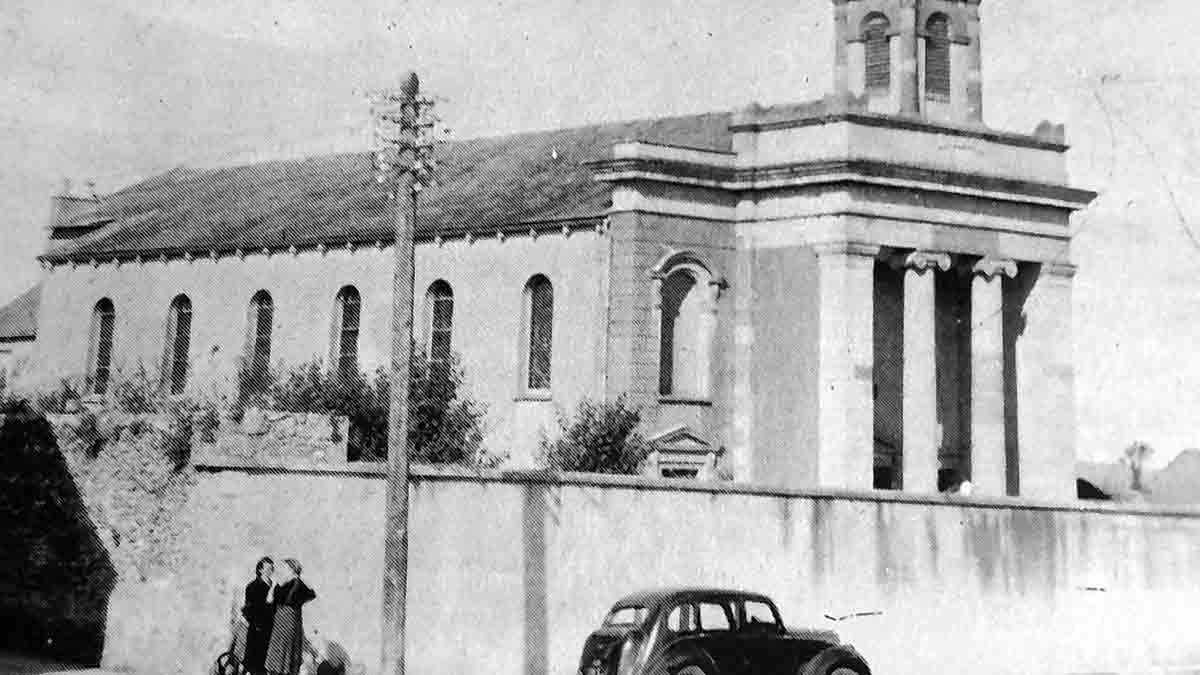
In recent years, that all-pervasive influence has been tempered somewhat by changing times, as in the rest of Ireland. Overall, the church has been a force for good in Callan. And the Big Chapel, focal point of the infamous Schism that ripped the town apart in the late 19th century, is a genuine artistic and architectural gem.
Building of it began in 1816 and it was completed in 1843. It is one of the finest examples of the neo-classical style in Europe. It replaced an ancient stone church referred to as “The Mass House on the Green”, a humble structure which had served the people for generations but had fallen into disrepair.
The ceiling was completed in 1834 at a cost of £120. According to an English visitor, it was “chastely and handsomely carved.” The gallery cost £50, and the architect who designed the impressive pillared entrance charged £15 for his services.
The fine tenor bell was installed in 1853, setting the parish back about £75, and the organ arrived in the church in 1844 from the concert rooms of Brunswick Street, Dublin.
Three beautiful oil paintings overlook the altar. Fr. Foran, an Augustinian friar in the early part of the 20th century, painted them all.
During Dean Howley’s term in Callan, which spanned the first decade of the 20th century, the old windows were removed and replaced with the beautiful stained glass ones. Four new confessionals were installed. The Dean explained these would accommodate a growing need for repentance and forgiving of sins in the parish.
The Stations of the Cross were gifts from different parishioners. Marble altar railings, sculpted in Pat Molloy’s yard by expert craftsmen and donated by James Pollard, enhanced the aesthetic appeal of the church.
Mr. Pollard was a devout “Holy Family” man, attending the regular meetings at which prayers were offered and locals who set themselves the task of upholding the Catholic ethos in the parish reviewed the moral status of Callan and District.
The walls were wainscoted in pitch pine. Glass panelled doors were added to the porch, and ornamental railings were erected around the baptismal font. With the Callan Electrical Plant up and running, paraffin lamps in the chapel gave way to the wonders of electricity.
The Dean said: “Let there be light” …and the generator in Lynch’s old Mill transformed the interior of God’s House in Green Street. When the electric bulbs were first switched on in the chapel, people shielded their eyes from the unaccustomed brilliance. Some feared they had been blinded.
The bulbs illuminated parts of the church that up to that point had been shrouded in darkness or a shadowy half-light. Worshippers thanked their creator for bathing the church in what the Dean described as a “heavenly radiance, a pale imitation of the light of God above… that shines in the heart of a true believer.”
An equally memorable occasion for the Big Chapel was the day Carnegie’s Organ was added to its heavenly core. The new church organ was so-called because Andrew Carnegie, an American multi-millionaire, had donated £200 towards the cost of it.
Local newspaper correspondent Peter Roughan gave the date of its installation in the church as Sunday October 2nd, 1910. Dean Howley had been no armchair fundraiser in the marathon drive to find the money to pay for the benefit of upgraded musical accompaniment.
Over several months of 1909, he had drunk seemingly endless cups of tea in kitchens across the length and breadth of Callan, Coolagh, and Newtown parishes while politely and tactfully seeking a little financial support for the much needed “organ replacement”.
He collected a total of £200, a considerable sum for that time. When pooled with Carnegie’s donation, the parish could afford an organ that mass-goers had only dreamt of. Though the people had little to give, it all mounted up. Peter Roughan recalled where the money came from:
“T’was made up of farmers’ florins, and county men’s coppers. There were no ten bob notes at that time- we used to call them “Bradburys”, but there might be a fair sprinkling of pound notes flung into the collection. In any case no one will ever be able to tell the number of notes, musical ones- that the Dean’s collection brought out, aye, millions and millions of them…since the organ was opened in the Big Chapel”.
The old organ that it replaced was believed to have been purchased in Dublin in 1852 by Callan’s PP after he had seen it perform at the Great Exhibition in the capital of that year. It was a hand-pumped organ, and locals took turns operating the bellows.
John Barron, the chapel clerk, was one man who wasn’t sorry to see the old organ replaced. He had worn himself out, pumping air into it, whereas the new one required just a few strokes of the handle to fill the bellows.
But the old organ had served the church well for sixty years, and accompanied some of Callan’s best-loved and most talented singers: Among these were Molly Hennessy, Babs Tobin from Mill Lane, Mary Bridget Kearns (later Mrs. Jones of Windgap); Jimmy Landy; Mickey Kealy; Pat Dooley; and Jack Rice.
(To be continued…)