


BY JOHN FITZGERALD

(Part One)
Farmers kept the country “fed and watered” throughout the Emergency years (1939-45). So recalled Nell Leahy.
They coped better than most urban dwellers with the wartime restrictions and shortages, she confirmed, being well used to riding bikes or pony and traps in preference to motor cars, having their own meat and vegetables, and in many cases their own fire fuel to warm the house and cook the meals.
Country folk operated a barter system that enabled them to get by. They had borne the hardships occasioned by the Economic War of the 1930s, so the Emergency was to them just another challenge to overcome.
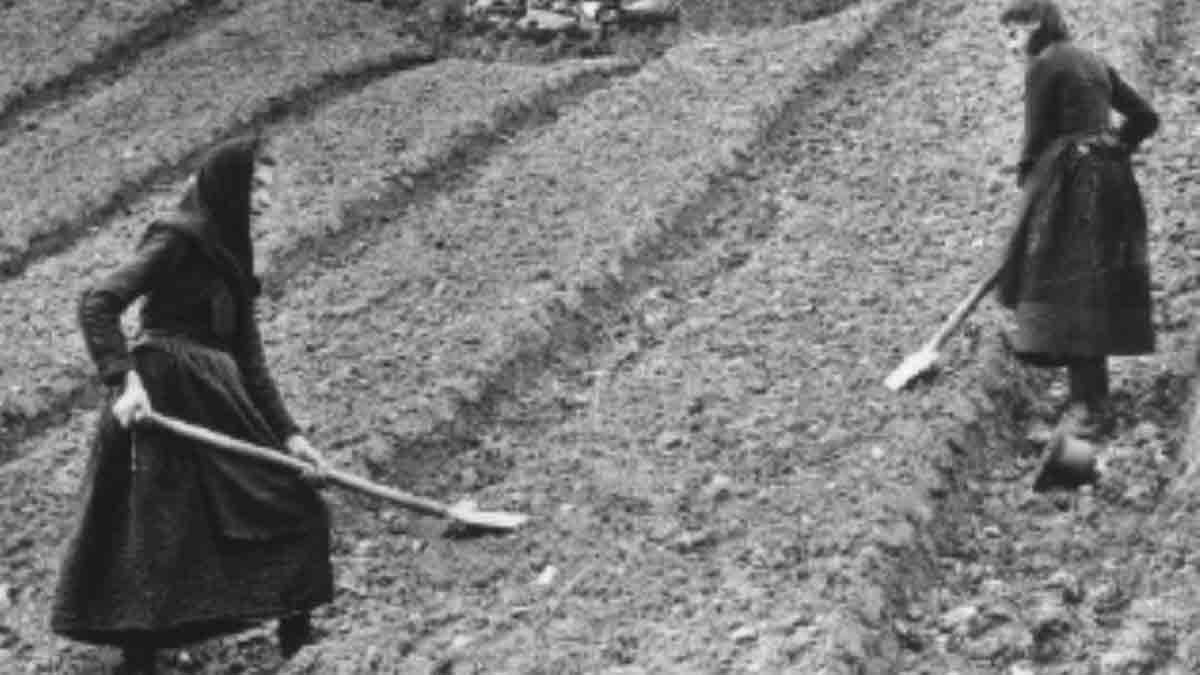
Nell observed how they continued to “plough the land, sow the seeds, save the hay, dig the potatoes and turnips, and harvest the beet crop”. Their dairies went on producing milk, butter, and cheese. They reared livestock, as before the war and after, for beef, mutton, and bacon.
In spring the corn was grown, and in March the spuds, which had to be looked after meticulously to avoid the ravages of severe frost that came in April and May.
Mangolds and turnips were sown in early June, and beet in April. The beet was generally harvested in October. The potatoes were ploughed up in the same month, and stored in barns or outhouses to shield them from the winter frosts. A few farmers stored the spuds in deep covered pits in their fields.
In October also the mangolds were pulled and clamped on the land. They were left to dry for a few days, then taken to the farmyard, placed in a pit, covered with clay and carefully thatched with straw to keep out the frost.
The turnips, by contrast, were allowed to remain in the ground until a little after Christmas. The farmers pulled and snagged them. They fed some to livestock, but many turnips ended up on dinner plates.
Most farmers in the Kyle district, Nell noted, had dairies. As a rule, a farmer with sixty acres kept up to eighteen cows, while a farmer with forty acres tended to confine his herd to about fourteen.
They fed their calves on the skim milk they took home from Callan creamery. In addition to rearing pigs for the Callan Bacon factory, farmers kept a few for themselves, to guarantee a regular supply of rashers, black and white puddings, meaty ribs, and the occasional pig’s head.
In May, mostly horse-drawn mowers mowed the un-spoilt meadows of ripe grass around Callan, with the clampdown on spare parts for tractors keenly felt up to war’s end.
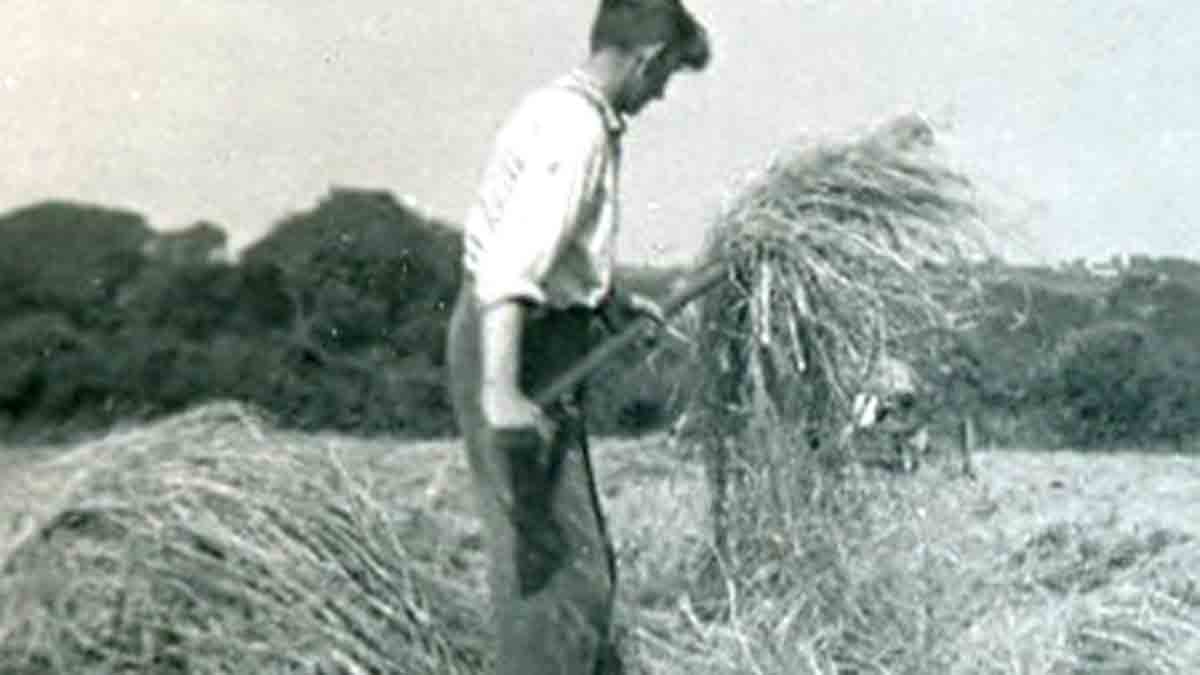
A day or two after cutting, the farmers turned the hay (weather permitting), first into lines along the field, then forming it into small cocks with their pitchforks, then into larger “tram” cocks.
These were tied down with sugauns and remained in the field until the farmer was ready to cart it to his haybarn or build it into a rick to retain as winter fodder.
The story of corn harvesting had a special appeal for Nell, with its memories of threshing days in Kyle and the countryside around Callan. Nell recalled an activity that provided a lucrative source of income for both farm families and quite a few “townies” in the war years. This was the catching of rabbits in the countryside. A huge market for the humble creature had opened in Britain.
Advertisements appeared in the Kilkenny Journal. “Rabbits wanted…in any quantity!” and “Earn good money…give us rabbits!” the ads declared, enticingly. Clover Meats in Waterford bought vast numbers of them.
With rabbits plentiful, men and boys stalked the fields around Callan and district, laying snares to grab the unsuspecting creatures. Lamps and traps were also used in killing them. Butchers across the water paid handsomely for rabbit meat, which wasn’t affected by rationing, and rabbit fur was used to line the uniforms of hard-pressed British fighter and bomber pilots.
The demand for rabbits persisted up to war’s end. Jimmy Walsh of Green Lane (and later Mill Street) remembers seeing the Town Hall building on market days during the Emergency festooned with rabbit carcasses, displayed from floor to ceiling, inside the Green Street entrance.
Jimmy also recalled seeing the Bretts of Windgap busily shooting rabbits in 1942 in the Callan area. Day after day, he heard the crackle of a .22 rifle when he and his schoolmates went out to play in the countryside and he spotted Jackie Brett loosing off at the bunnies. The Bretts were ambitious, hard-working business people and, in later years, Jackie’s sons were successful as agricultural merchants.
Though it was a trying time for this creature originally introduced to Ireland by the Normans, a more direful fate awaited it after the war. Nell Leahy said she cursed the day the infamous and diabolical myxomatosis was deliberately inflicted on the rabbit population to control numbers.
Instead of facing the trap or snare, to serve as food in rural Ireland or be exported to Britain, they were doomed to die slowly from this man-made disease.
“Nature should have been let take care of itself” Nell opined.
Extract from my book Are We Invaded Yet?
(To be continued)